October 8, 2026
Roof Leak Repair in Marietta: How to Find the Real Source
By @emilianomvrn405
A roof leak can make a calm afternoon feel urgent fast. You notice a water stain on the ceiling, a drip near a light fixture, or damp drywall in a corner that was perfectly dry last week. The natural impulse is to focus on the spot where the water shows up indoors. That is almost never the full story.
When people in Marietta start looking into roof leak repair, the hardest part is often not patching a hole. It is finding the true entry point. Water moves. It follows framing, underlayment, flashing edges, and gravity in ways that can fool even careful homeowners. By the time it appears inside, it may have traveled several feet from the place where it first got past the roof system.
That is why good roof repair starts with diagnosis, not guesswork.
The leak you see is rarely the leak you have
One of the most common mistakes in roof leak repair is treating the ceiling stain as if it points straight up to the problem. In real life, roofs shed water across layers and transitions. If flashing is loose near a wall, if a valley is handling concentrated runoff, or if wind-driven rain gets under a vulnerable edge, the moisture may enter in one place and show itself somewhere else entirely.
This is especially important after storms. Research and field guidance consistently point to wind and hail as major causes of roof damage and water intrusion. Hail can damage roof coverings and shorten the life of the roof. Wind can disturb water-shedding details that looked fine from the ground. A roof may appear intact from a quick glance in the driveway and still have a leak path at a flashing detail or valley.
In Marietta, that matters because local weather events can create exactly the kind of hidden damage that turns into an indoor leak days later. A homeowner sees the stain, assumes the nearest shingles are the problem, and asks for a small patch. But if the real issue is uphill at a valley or where the flashing meets the shingles and underlayment, a patch in the wrong place only delays the repair.
Why valleys and flashing deserve so much attention
If you talk to experienced roofers long enough, two details come up again and again in leak investigations: flashing and valleys.
That is not by accident. Valleys collect and channel a lot of water. They are not passive parts of the roof. They are high-traffic drainage routes, and because they concentrate runoff, small installation problems there can become big leak problems quickly. Guidance from roofing and hazard-resistance experts has long emphasized that valleys are common leak points for exactly this reason.
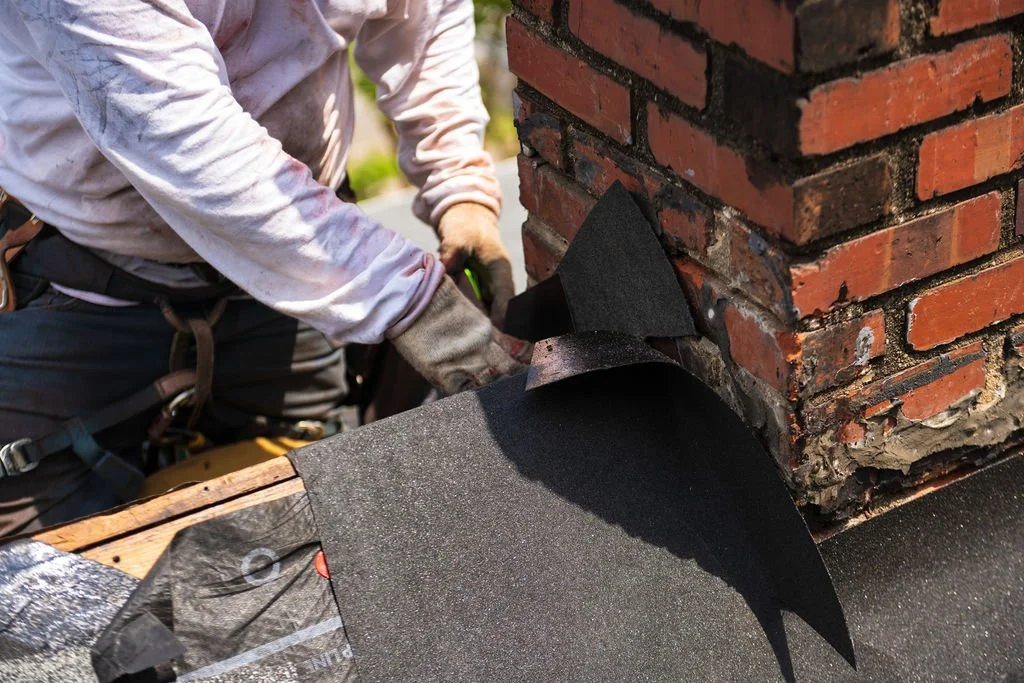
Flashing is just as important. Wherever the roof changes direction or meets something else, such as a wall or another roof section, flashing becomes part of the water-shedding system. If flashing is poorly installed, loosened, or not integrated correctly with the shingles and underlayment, water can get in. That integration matters. A roof is not just shingles on wood. It is a system, and leaks often happen where one part of that system stops working with the others.
That is why a good leak investigation does not stop at the obvious surface area. It follows the water path uphill and outward. It checks transitions. It pays attention to concentrated runoff areas. It looks for signs that the roof covering may not be the only issue.
What often throws people off in Marietta homes and buildings
Many leaks become harder to trace because they are intermittent. A roof may leak only during a hard, wind-driven rain and stay dry during a gentle shower. It may leak only after debris changes the flow of water through a valley. It may show up only when a storm hits from one direction.
That intermittent behavior leads to a lot of false confidence. If the stain dries out, people assume the problem has resolved itself. If a quick patch gets them through one rainfall, they assume the source was fixed. Then the next storm exposes the same weakness, or a related one nearby.
Commercial properties can be just as tricky as houses, sometimes more so. The principle is the same: the visible symptom is not always the source. The person handling the job needs to understand leak tracing, storm-damage assessment, and code and permit compliance where applicable. In the Marietta area, that means working within Georgia licensing rules and local permitting requirements when the scope of work calls for it.
A practical way to think about leak tracing
The cleanest way to approach a roof leak is to separate symptoms from causes. The symptom is what you can see indoors. The cause is the point where the roof system stopped shedding water properly.
A careful roof leak repair process usually starts with the interior evidence. Where is the stain? Has it spread? Is the drywall soft? Is the problem near an exterior wall, a roof intersection, or below a section known to take heavy runoff? Then the investigation moves outside to look at the roof geometry and vulnerable details above that area and, just as importantly, upslope from it.
This is where experience matters. Not because roof leaks are mystical, but because they are deceptive. A person who handles roof repair every day learns how often the water enters at one elevation and appears at another. They learn not to chase the stain. They chase the path.
Clues that the source may be somewhere else
A few patterns show up often enough that they are worth keeping in mind:
- A ceiling stain sits several feet away from the nearest roof transition.
- The leak appears only during wind-driven rain, not every shower.
- The area above the stain includes a valley, flashing detail, or roof-to-wall connection.
- The roof leaked after hail or strong storms, even though no large opening is obvious.
- A prior patch helped briefly, then the leak returned.
None of these clues proves the source by itself. Together, they point toward a diagnosis problem rather than a simple exposed-hole problem. That distinction saves time and money, because a repair aimed at the wrong spot is still the wrong repair.
Storm damage changes the investigation
After severe weather, homeowners are under pressure. Water is getting in, schedules are backed up, and there is often a sense that any contractor who can show up first must be the right one. That is exactly when careful decisions matter most.
Georgia insurance guidance for severe weather gives homeowners a sensible first response: photograph the damage, notify the insurer promptly, tarp the damaged roof if it is safe to do so, and avoid signing with rushed or unsolicited contractors. Those steps do two things at once. They help protect the property from further damage, and they help you avoid making a panicked commitment before the source of the leak is understood.
That caution is worth repeating. A hurried sales pitch is not leak diagnosis. If someone is eager to promise a fix before explaining where the water is entering and how the roof system failed, slow the conversation down.
For some storm-related losses, assistance or insurance verification may involve an on-site inspection. FEMA guidance notes that ceiling and roof damage from disaster-caused leaks may be eligible for assistance in some situations, and verification is typically done in person. That means your documentation matters, and so does having a repair professional who can describe the damage clearly and accurately.
Temporary action versus real repair
There is nothing wrong with a temporary protective measure when water is actively entering the building. In fact, it can be the responsible thing to do. A tarp, if it can be installed safely, may reduce further interior damage while the source is being evaluated. What matters is understanding the difference between temporary protection and a completed roof repair.
A temporary covering buys time. It does not answer the underlying question. If a valley detail is failing, if flashing has loosened, or if storm damage has compromised the water-shedding path, the permanent repair needs to address that condition directly.
This may sound obvious, but it gets blurred in real life. People are relieved when the drips stop. They want the emergency to be over. Yet the strongest roof leak repair work often starts after the water is no longer pouring in, when someone has the breathing room to inspect carefully rather than react hurriedly.
Why the right contractor matters more than the fastest patch
In Georgia, contractor licensing is not a casual paperwork issue. The state requires licenses for residential-basic, residential-light commercial, and general contracting work performed for compensation. The rules include requirements tied to experience, age, competency, and examination. For commercial general contractor licensing, the knowledge base includes areas such as building codes, estimating, insurance, surety bonding, and liens. Insurance is also a condition of applying for and maintaining licensure.
For a property owner in Marietta, this matters in practical terms. If the leak repair turns out to involve broader contractor work, structural implications, or permit-triggering alterations, you want a roofing contractor or contractor team that operates within those rules. You also want someone who can tell you honestly when the job is simple maintenance and when it has crossed into a scope that requires permits or additional compliance.
Marietta requires building permits for new construction, temporary buildings, and certain alterations to existing construction. Marietta and Cobb County also enforce current Georgia building codes. Not every leak fix will trigger a permit, but some larger or more involved projects can. A trustworthy professional does not dodge that conversation. They handle it clearly.
This is one of the biggest differences between a real repair process and a quick patch culture. The quick patch says, “Let’s stop the drip today.” The real repair says, “Let’s identify the failed detail, fix it correctly, and make sure the work is handled within the rules that apply.”
Questions worth asking before you hire anyone
When you speak with a roofing contractor in Marietta, you do not need to interrogate them like a lawyer. But you should ask enough to understand whether they are diagnosing or just selling.
- Ask where they believe the water is entering, not just where it is showing up.
- Ask whether they see concerns at flashing, valleys, or other water-shedding transitions.
- Ask whether the storm may have caused damage that is not obvious from the ground.
- Ask whether the scope of repair could involve permit or code compliance issues.
- Ask how they document the condition before and after the work.
Those questions do not require technical expertise from the homeowner. They simply push the conversation toward evidence and away from vague reassurance.
The value of documentation, even for a small leak
Even a modest leak deserves a paper trail. Photos taken early can show the stain before it spreads, the weather conditions around the event, and any visible roof damage that may become less obvious later. If the problem turns local roof repair into an insurance claim, that record helps. If the leak returns, it helps again.
Documentation also keeps everyone honest. It helps a contractor explain why a repair is recommended. It helps the owner compare one proposal with another. It helps distinguish emergency stabilization from permanent roof repair.
This does not have to be elaborate. A few date-stamped photos, notes about when the leak appeared, and a record of any temporary tarping or emergency service can go a long way.
Why some repairs fail twice
When a leak returns after being “fixed,” homeowners often assume the first contractor was careless. Sometimes that is true. Sometimes the issue is more subtle. The first repair may have addressed a visible symptom, while the real source remained untouched.
A classic example is a stain near a ceiling corner below a roof section that includes both a valley and adjacent flashing. If someone seals the most obvious surface opening near the stain but does not correct the failing detail higher up, the water will continue to find its route. The leak may pause under lighter rain, then reappear during the next hard storm. The homeowner ends up paying twice for one problem.
That is why diagnosis should be treated as part of the job, not a free guess attached to the labor. The most effective roof leak repair work is often less dramatic than people expect. It is not about heroic patching. It is about correctly identifying the breakdown in the roof system and repairing that specific point of failure.
Homes and commercial buildings need the same discipline
There is a tendency to think of leak tracing as a residential headache and permitting as a commercial issue. In practice, both types of properties benefit from the same discipline: identify the source, understand the scope, document the condition, and complete the work in compliance with the rules that apply.
A Marietta-area contractor who handles both residential and commercial projects should be comfortable with that full chain. They should understand storm-damage assessment. They should know how to trace a leak beyond the ceiling stain. They should be able to discuss whether the work is simple roof repair or something that edges into a larger contracting scope.
That breadth matters because leaks are rarely convenient. What starts as “just a small spot” can reveal bigger concerns once the source is found. The value of an experienced professional is not only that they can repair what failed. It is that they can see the full context early enough to prevent a small issue from becoming an expensive one.
What homeowners can do right away
If water is entering the building, safety comes first. Protect people and belongings. Document what you can. Notify your insurer promptly after storm damage. If tarping can be done safely, it may help limit additional interior damage while you line up professional help.
Then slow down just enough to make a good decision. The right roofing contractor is not just someone who offers a fast patch. It is someone who can explain the likely path of water, inspect the critical details that commonly fail, and handle the work in a way that fits Georgia licensing requirements and local permit rules when needed.
That approach may feel less dramatic than rushing into the first offer. It is usually the smarter one.
Finding the real source is what saves money
People often think the cheapest repair is the smallest repair. In leak work, the cheapest repair is the correct repair. If you patch the wrong spot three times, you did not save anything. You only delayed the real fix while interior damage kept accumulating.
In Marietta, where storms, wind, and hail can all play a role in roof damage, the best first move is not to assume. It is to investigate. Pay close attention to flashing. Respect valleys. Understand that water can travel. Work with a qualified professional who knows the difference between a visible symptom and the actual breach in the roof system.
Once you find the true source, the repair path usually becomes much clearer. And that is the moment when roof leak repair stops feeling like a mystery and starts becoming a manageable job.
❧